Hannover Messe 2026: five signals actually reshaping the robotics market
At trade fairs, robotics is easy to stage in an impressive way.
An autonomously walking humanoid robot, a quadruped in a security scenario, or a strong pick-and-place demo can draw attention fast. But for companies that want to evaluate and deploy robotics in the real world, a different question matters:
What is actually ready for everyday operations?
During our on-site visit to Hannover Messe on 22 April 2026, we looked at exactly that — not just the show, but product maturity, integration capability, regulation, platform logic, and partner models.
Our main takeaway:
The market is no longer decided by which robot attracts the most attention. What matters is which provider can bring real applications into operations cleanly, safely, and economically.
From the conversations and demos on site, we see five clear signals.
This article is for decision-makers, innovation leads, and integration partners who want to evaluate robotics seriously — and move it into operations.
Maturity is shifting from the single robot to the platform
A single robot can look good on a trade-fair stand. That is not enough for real deployment.
What stood out most was where vendors showed not just a device, but a platform and operating approach: task planning, multi-robot control, scheduling, alerting, and a clear focus on repeatable workflows.
That is increasingly where demo ends and operations begin.
Companies should therefore ask not only:
- What can the robot do?
But above all:
- How are tasks planned?
- How does the system scale to multiple units?
- How is operations monitored?
- How are disruptions, charging cycles, and routines managed?
If these questions cannot be answered, you often have a demonstration — not a deployable solution.
CE, GDPR, and open interfaces are becoming real deal criteria
A recurring pattern across multiple conversations: regulation is no longer an afterthought.
Especially in the German and European market, what matters is not only motion capability, sensing, or hardware quality. The decisive factors are:
- CE readiness
- GDPR-compliant data processing
- open integration interfaces
- connectivity to existing alarm, control, or process systems
This is particularly visible in security, inspection, and industrial applications. A technologically interesting robot is not enough if integration, documentation, data protection, or future operator responsibility remain unclear.
Security and inspection are among the most mature early use cases
A clear picture from Hannover: security and inspection scenarios currently belong to the most robust early use cases.
Why?
Because the tasks are often structured, repeatable, and close to process:
- defined routes
- recurring checkpoints
- visual inspection
- alarm forwarding
- documentation of anomalies
These environments are well suited to introducing robotics in a controlled way and making value measurable.
That does not mean other use cases are unimportant. But it shows where real implementation substance is visible today — rather than attention alone.
Strong hardware alone is not yet a market-ready customer solution
Several systems at the fair looked technically or visually strong. Sometimes the hardware was convincing, sometimes the staging, sometimes the dynamics of the demo.
Still, a similar open question remained with multiple vendors:
How does this become a complete solution for the customer?
Between a hardware demo and real operations lie exactly the topics that get too little attention early on:
- use-case design
- software and process integration
- operator logic
- data protection
- service and support
- partner and role clarity
If there is no solid answer here, risk is often pushed onto the customer or integrator.
For the market, that is a maturity question. For customers, it is an investment question.
Training logic, partner readiness, and deployment decide scalability
What mattered to us was not only whether a vendor shows exciting systems, but how they think about the path into real applications.
Three factors matter from our perspective:
- How are systems trained or taught for concrete use cases?
- What role do integrators, partners, and on-site deployment play?
- Which demo, pilot, or financing models lower the entry barrier?
Hannover made it visible how strongly vendors are already diverging here.
Some already think in platforms, training environments, partner models, and scalable operating logic. Others look technologically exciting, but still leave major parts of the solution entirely to the customer.
For companies, that is central:
Not every strong technology is automatically a good starting point for your own project.
The five signals at a glance
Signal Why it matters What companies should check Platform over single robot Operations need task logic, monitoring, and repeatability How are tasks planned, scaled, and monitored? CE, GDPR, and interfaces Regulation and connectivity decide real deployability What documentation, data-protection logic, and integrations are available? Security and inspection Structured, recurring tasks suit early robotics projects Which routes, checkpoints, and escalation paths exist? Hardware is not yet a solution Customers need processes, service, roles, and operating logic Who owns integration, support, and further development? Training and deployment Scale only emerges through teaching, partner readiness, and rollout logic How is the use case validated, piloted, and later transferred?What companies should take away from Hannover Messe 2026
If you plan to evaluate robotics seriously over the next 12 to 24 months, do not start with the question of which robot looks most spectacular.
A more useful entry point is this:
- Which use case is genuinely relevant to operations?
- What requirements apply to data protection, safety, and integration?
- What platform and operating logic is needed?
- Where do real costs lie — not only for hardware, but for rollout and operations?
- What partner structure is needed to turn pilots into sustainable applications?
These questions decide whether robotics ends as a showpiece or starts as a robust solution.
Our impressions of selected vendors
Beyond the broader market signals, direct impressions of individual systems and vendors also mattered. Not as a final ranking, but as perspective on product maturity, integration capability, and market fit.
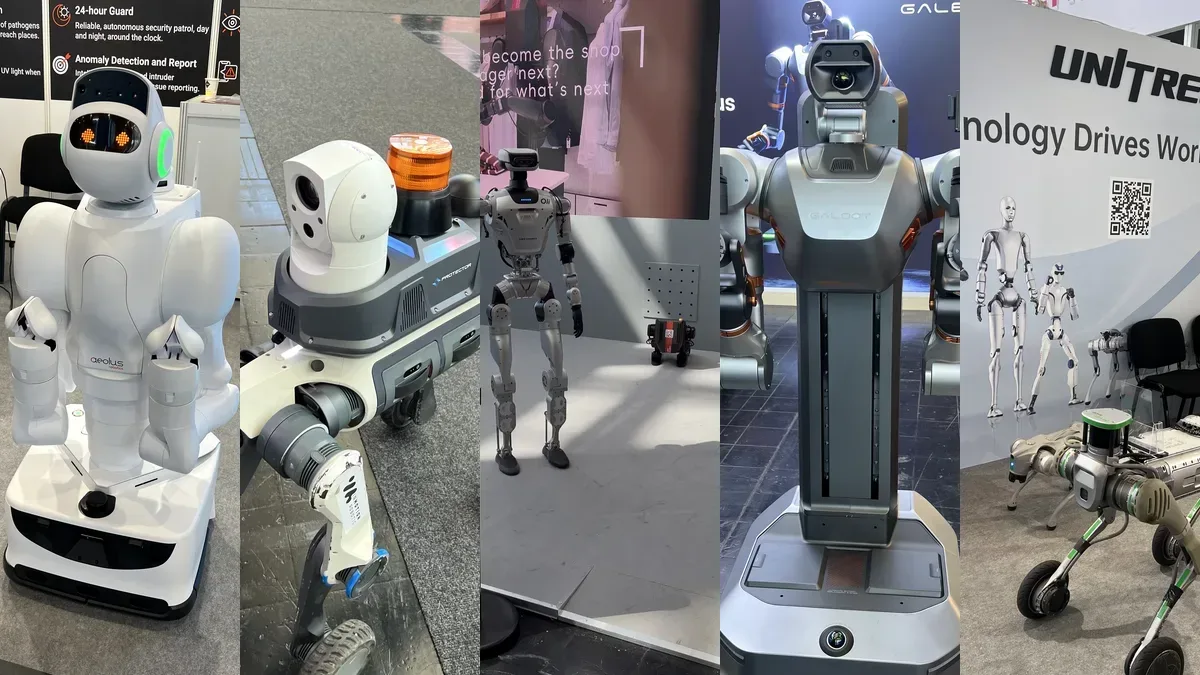
Selected systems from our conversations and observations at Hannover Messe 2026. What mattered was less the staging than the question of maturity, integration, and operational readiness.
Aeolus
Aeolus felt comparatively mature. What stood out positively was that the company showed not just a single robot, but already a robust platform approach with task-based control, scheduling, and multi-robot logic.
That was especially relevant for security-adjacent scenarios. At the same time, CE and data protection remain central checkpoints for European rollout.
In Motion / Protector
The quadruped approach in security and inspection was one of the most interesting meetings of the fair. What mattered was not only the hardware, but the combination of open integration logic, regulatory orientation, and clearly visible partner and deployment thinking.
We see high relevance here especially for applications where security, alerting, and recurring inspection routes come together.
Agile Robots
Agile Robots left a mature and application-oriented impression. What interested us most was that the company showed not only product presence, but also the logic of training and use-case teaching.
For industrial scenarios in Germany, this is a vendor we would examine more deeply.
LimX Dynamics
Technologically, LimX Dynamics was very strong. Mobility, dynamics, and teleoperation were impressive and clearly show the potential in such platforms.
At the same time, it was equally clear that this does not automatically become a finished customer solution. From our perspective, this is a capable hardware base that still lacks a complete operating context without additional integration and software partners.
GALBOT
GALBOT felt high quality at product and presentation level. The pick-and-place approach shown was concrete enough to make application proximity visible.
Open questions for us remained around partner structure, market approach, and regulatory maturity in the European context. These are exactly the points that decide whether a strong demo also becomes robust market access.
Terra Robotics and Unitree
These conversations were also relevant, especially for the sales and market picture. At the same time, they made clear how important it is to distinguish between product availability, integration maturity, and actual implementation depth.
That is why vendor-neutral perspective is more valuable for many companies today than pure product proximity.
What this means for Veyra Robotics
Our impression from Hannover Messe 2026 confirms very clearly why a vendor-neutral approach is gaining importance in the robotics market.
Companies today need more than access to technology. They need:
- orientation in a fragmented vendor landscape
- realistic assessment of maturity levels
- robust use-case evaluation
- clarity on integration, regulation, and operating models
That is exactly where Veyra Robotics comes in.
We want to make robotics not only visible, but tangible, comparable, and economically useful.
If, after Hannover Messe 2026, you need a robust decision framework for your next robotics step — not more impressions — talk to us.
Learn more at /en/kontakt or on our solution pages at /en/loesungen.